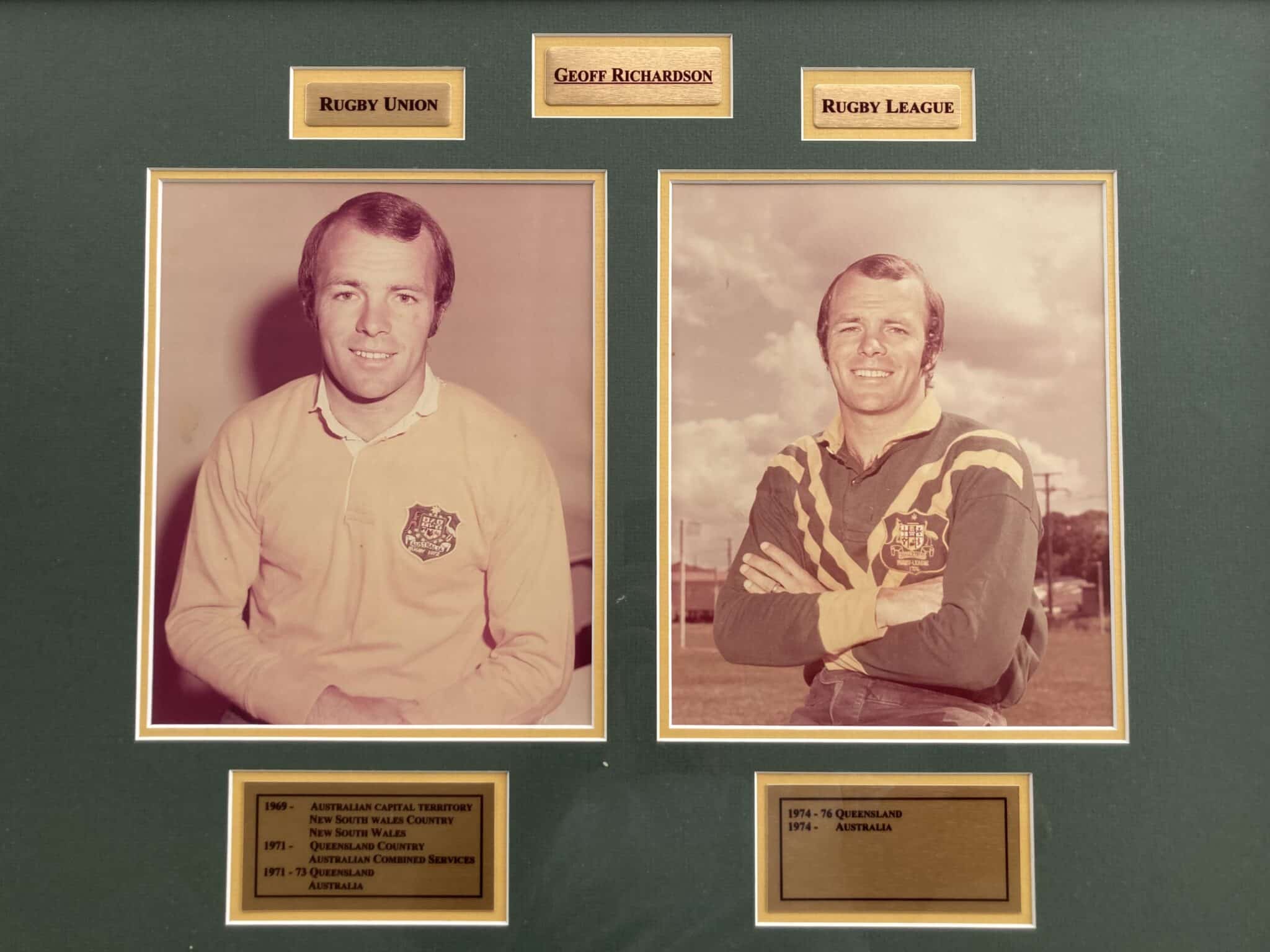

There are many ways people like to remember measure or remember sports. Scores, results, places and memories are a few.
Amongst those memories are the teams and friends you made along the way, each item of clothing and team gear you save representing another time, another place, another team.
And while it’s only one measure, there would be very few people in Australian sport with a wider variety or greater quality of ties, caps and blazers than this Dirty Reds legend collected from an amazing yet relatively short playing career. He has ticked off an incredible number of boxes… let’s start with a quick glance.
If you heard about someone who had played for Australia in two separate sports, you’d readily acknowledge that as an amazing achievement.
If you heard about someone playing one of those sports for three separate states, you’d no doubt think that’s unheard of – a supreme rarity.
And if a person did both of those things it would be scarcely believable. And yet those are just some of the achievements of former Goulburn Dirty Red, former Wallaby and former Kangaroo Geoff Richardson over a relatively short career.
For some, who may not know and can’t quite place the man, his name may ring a bell from seeing it inscribed on top of a prestigious trophy in the club’s trophy cabinet, or from hearing it read out when it’s time to announce the Club’s Best Back Award. And the trophy bares his name for good reason.
His career was one to take great pride in, and the Dirty Reds are rightly proud of Richo, but he wasn’t actually from Goulburn. His footy story commenced at Taree where he started out doing anything he could to be involved… mascot, ball boy and player.
How it all began
Richo’s journey as a player began at age 12 and by the time he was 15 he was playing under 18s for Taree Old Bar RL Club. From High School he went to Newcastle Teachers College (who he played rugby for) from 1967 and then would hitch home to Taree to on Saturday arvo to play league for Taree Old Bar A Grade the next day. In that first year of senior rugby the talented fly-half/centre was selected in the Newcastle rep team at Country Week and after two years at teacher’s college he got his first posting… in the bush. To the Dirty Reds’ great fortune, he was sent to the Goulburn region.
“My first teaching post was split between three days a week at Crookwell High School and two at Gunning Central School,” Richo reflected.
“I had to ask where Crookwell was and was just told it was cold down there and they good food including roast lamb and potatoes. They were right about both. The first time I headed to Crookwell I hit gravel road near Pejar Dam and thought to myself `where am I going?’ “.
His life soon fell into a comfortable pattern. After working at Crookwell in the first part of the week, on Thursdays he would travel to Gunning to teach all day, head into Goulburn after school and help close Klem’s Bakery, (often filling up on some samples) before rugby training with the Dirty Reds. That was often followed with some social time at the Rugby Club and then driving back through often inclement weather to Crookwell to sleep, sometimes bunking down at John Klem’s at Bannister, and do it all again.
Richo had barely begun his playing days with the Dirty Reds when he was selected in 1968 for ACT at Country Week, (where the Territory team played at that time) which led to representing the Minister for the Interior’s XV against the Australian Services XV where he marked a young and up and coming Bob Fulton at Centre. Their paths would cross again, both as opponents and team mates, in 1974 and 1975 in rugby league… but that was yet to come.
As his abilities continued to develop and his reputation began to grow, the talented player was selected in rapid succession for ACT, NSW Country (against Fiji) and NSW (also against Fiji) in 1969.
“The NSW Country match against Fiji was very unforgettable,” he reminisced.
“It was the same month Armstrong landed on the moon. Our team had a warm fire in a solid brick hotel in town while Fijian’s froze out on edge of town in small fibro motel. Bill Gunther was NSW Country coach, having been a Wallaby backrower from Orange. His team talk was basic- “hit them hard and often, if they get up, hit them hard again”!”
When the army called

God only knows what things he may have continued to achieve for the Goulburn Dirty Reds had he been able to continue here, but fate had other ideas. Conscripted in 1970, he found himself at Singleton Army Camp and was selected for Officer Training at Scheyville, north west of Sydney.
“This was an intensive six month course and I was refused leave to play outside rugby,” said Richo.
“We played inter-company rugby, soccer and Aussie Rules in winter sports afternoon. In these games I had to play my own game as well as help direct other cadets in my company team from Victoria, South Australia and Western Australia how to play this new game.”
Committed as he was, and enjoying as much as he was, Richo missed the best part of a year of club and representative rugby in 1970.
He was posted that same year to Townsville to join 6RAR Battalion as a 2nd Lt. and had a few games at the end of 1970 season playing in the Townsville rugby competition.
He represented Queensland Country and Queensland in the early part of season 1971 while still based at Townsville Townsville before transferring to 8/9 RAR (Enoggera Army Base) in Brisbane mid-year, and it was a match in Brisbane that was particularly life-changing.
“My first Queensland XV match was against the British Lions who were on their way to a successful tour in New Zealand,” Richo said.
“We won 18-11. In that match a young woman named Susan Francis, who was selected as Miss Queensland Rugby from a promotion through the clubs, brought the match ball onto Ballymore field and gave it to me to start the game. I later married her and we’ve recently celebrated 52 years together.”
A momentous year. He won a heart and shortly would earn a Wallaby cap.
For Richo, that year included Queensland Wallaby Trophy games against Victoria, NSW Country and Sydney, and games for the Australian Services Rugby Union including against Sydney on the parade ground at Victoria Barracks, against Victoria at Olympic Park in Melbourne. and against former team mates when he played against Queensland. And to cap off the year, selection for Australia.
In context, these were heady days. Protestors abounded at many events. Many weren’t happy with Australian troops fighting in the Vietnam War, many were also displeased, in the days of Apartheid, that the Springboks were here. Richo was at the forefront of both activities but did not get involved with demonstrations.
Wallaby debut
“My Wallaby debut was against South Africa at the Sydney Cricket Ground,” Richo remembers.
“It was a huge occasion for me, not just because of the honour of representing my country but because of the significance of the occasion. I met the Prime Minister, and people were throwing smoke bombs, there was a lot going on but out in the middle it was all about rugby.”
That year proved to be a busy one, representative rugby-wise…he played the Springboks in five matches – three Tests – and played for Queensland Country at Toowoomba and Queensland in Brisbane at the Exhibition Ground. He then finished the year with a Wallaby tour against France, America and Canada, captaining the Wallabies against a French Selection at Bayonne.
You’d find it hard to believe if you were told any one person had achieved half of these accomplishments, but Richo was just warming up.
In 1972, Richo played for Brisbane, Queensland and Australia, including a two-test Wallaby tour of New Zealand and one test against Fiji.
In 1973 he again played for Queensland and Australia (including two tests against Tonga) and a Wallaby tour that included games against Wales, England and Italy. That tour was a poignant reminder that (as Simon Poidevin famously coined) you played rugby for love not money when the Education Department in Queensland approved Richo’s seven weeks leave, but without pay. This was six weeks before he and Susan were to be married!
That tour called curtains on his rugby career, but his rugby league career was only just about to start.

Switching codes
In 1974, while playing for Western Suburbs Panthers in the Brisbane competition, he played for Brisbane, Queensland and Australia (all places he’d already represented in rugby). His rugby league Australian matches that year consisted of two tests against Great Britain.
The following year, 1975, he represented Brisbane and Queensland in league again and won the Brisbane premiership, and then represented Brisbane and Queensland again the next year AND won the premiership again.
In his international rugby league career he played alongside some absolute legends of the game and mor than a few Immortals… men like Artie Beetson, Graeme Langlands, Bobby Fulton, Ron Coote, Mick Cronin… experiences and friendships he thoroughly enjoyed and still treasures. But if you were to ask him the best footballer he played with his answer was a Wallaby. Former halfback team mate John Hipwell.
And after all of those achievements, after all of those representative honours, Richo was only 27 years of age.
To have squeezed all of these achievements into a decade of senior football is phenomenal. But he had other things he wanted to make a greater commitment to. He stepped away from representative football of either code. Well, mostly. In 1991 Richo represented the Classic Wallabies tour of Bermuda… still setting up plays, still running around the paddock with a big grin. But in 1977 he made the decision to concentrate on his family and his career as an educator and has never regretted the decision.
Mind you, rugby (and Goulburn) were still very much a part of him. So much so that in that first year of football retirement, while he was the sportsmaster at Brisbane Boys College, he led the College’s 1st XV on a tour down south that included a visit to Goulburn where they played a combined team from St Pat’s and Goulburn High School players. While staying in Goulburn they were billeted with some of the Goulburn Rugby faithful, including once again John Klem. Richardson himself and his wife stayed with club stalwart John Osmond.
His education career continued, unsurprisingly, quite successfully and filled with great variety and accomplishments, but that is a tale for another time and another context.
It is his football career that we’re talking about on this particular occasion… a career that included:
RUGBY UNION: Newcastle, ACT, NSW Country, NSW, Townsville, Queensland Country, Brisbane, Queensland, Australian Services Rugby Union and Australia.
RUGBY LEAGUE: Brisbane, Queensland, Australia and two Brisbane premierships.
A Wallaby and a Kangaroo… precious few people can claim to be both. And a Dirty Red! And when you add in all the other representations surely, as mentioned earlier, it’s an unparalleled collection of caps, ties and blazers.
As to his memories of Goulburn, Richo rates those two years as an exceptional time professionally, socially and sport wise. And even with all of the memories he accumulated across his meteoric career, memories from his days with Goulburn are amongst his most treasured.
“The life experience of playing in Goulburn and working in Crookwell and Gunning were great,” Richo said.
“There are so many great rugby stories from Goulburn… too many to list them all. And some, you just had to be there.
“I remember stopping at Bredbo Pub on return from a club match versus Cooma and we had such a big night there that and our Kiwi flanker was found asleep by the cleaner in the upstairs toilet in the Goulburn Rugby Club the next morning!
“I fondly remember the 1968 pre-season trial game at Kiama and I had the chance to hit the surf with a great bunch of country guys.
“Another great adventure was a return trip from 1969 pre-season trial versus the Orange Emus. The Dirty Red lads were still thirsty and they convinced the Trunkie Creek publican to serve them some more drinks out the back of the pub , after hours. FOR hours!”
“I had great experiences in Goulburn and built friendships in the area that continue to this day. Goulburn Rugby was a good club to be part of, mixing with players of various ability and all walks of life, with a team desire to take down the Canberra Ra Ra’s. I still follow the Club’s ongoing success with pride.”
So when you hear his name at a Goulburn Rugby Club prezo dinner, or see it as you walk past the trophy cabinet, give a thought to the man who played two seasons with the Dirty Reds and went on to become one of the most widely selected players either rugby code has ever seen. If you win the award named in his honour, don’t forget, those are pretty big boots to fill.
Please note, all research in this article provided by John Osmond.

The 1974 Australian Rugby League team.